Destinations India offers online reservation for The Spirit of India Tour Itinerary, India

  Destinations India                                                                     Tourism and Travel Places in India

Destinations IndiaDestinations IndiaDestinations India
Home
   Know India Better   Taj Mahal   Golden Triangle   Coach Tours to India   Hill Resorts in India
   Palaces of India   Wildlife Tours of India   Kerala Backwaters   Palaces on Wheels   Adventure Tours of India

Trinetra's Special Price Tours

   Best of India, Nepal and Tibet
   Best of India
   Best of Kerala
   Best of South India
   Golden Triangle with Himalayas
   India- Short and Sweet
   India- By Day and Night
   Jewels of the Crown
   Kerala Delights
   On the Lord's Footsteps
   South India Explorer
   Taj and Tigers
   Temples and Tigers of India
   The Crowning Glory Tour of India
   The Spirit of India Tour
   Tigers, Palaces and Beaches of      India
   Tigers, Temples and Rajasthan      Heritage
   Rajasthan Heritage and Goa
   Rajasthan Heritage with Varanasi
   Romantic Rajasthan
more..  

Home
Know India Better
Palaces of India
Taj Mahal
Wildlife Tours of India
Golden Triangle
Kerala Backwaters
Coach Tours to India
Palaces on Wheels
Hill Resorts in India
Adventure Tours of India
Tour Packages
Highlights | Itinerary

The Spirit of India Tour


Day 01: Arrival / Delhi

Late night arrival. Meeting and assistance upon arrival as our representatives welcome you and escort you to your car.

Whilst the room keys and check-in is organized, our representative would introduce the tour to you and hand over the documents to you.

Welcome to India, or as we say 'atithi devo bhava' (the guest is an incarnation of God). Thank you for giving us the opportunity to serve you!

Day 02: Delhi

Following breakfast, we proceed on a guided tour of New Delhi, Visiting such sights as Bahai Temple, Humayun's Tomb (1586) , the Qutab Minar 72 meters high and one of the most perfect towers in the Persian world. The Iron Pillar which has survived the vagaries of weather for over 1500 years. Continue with a drive through Embassy area, the Government buildings (1921-1930) and Connaught Place, the heart and main shopping district of the capital.

Afternoon we cross the city and into the walled gates of the Old city with visits to the Jama Mosque (1650) and drive through the fabled area of Chandni Chowk (aptly translates to Moonlight Square) where the throngs of shoppers and vendors meet in the oldest area of Delhi. Visit the Red Fort (1639-1648 built by Shah Jehan the builder of the Taj Mahal in Agra) to view the inlaid and carved Royal Chambers, on to Raj Ghat and nearby ghats where the founder of the nation, Mahatma Gandhi and thereafter Indira Gandhi and Rajiv Gandhi were cremated.

The highlight of this tour would be a ride on cycle rickshaws. Now these are 3-wheel cycles with a sofa seat at the back. The Rickshawalla (Rickshaw driver) sits on a small cushion in the front and two passengers on the sofa seat behind. This is a remarkable way to explore and picture the hustle and bustle as well as the colour of the narrow winding streets bursting with people and pavement shops selling wares of all description - including a laughing set of dentures. The ride would be accompanied by peals of laughter both from the passengers as well as the onlookers.

Home Visit & A Welcome Dinner: This evening we would visit an Indian family for an Indian home experience. The evening is designed to give you a 'feel' and insight into Indian family life as well as experience typical Indian hospitality and home made Indian food.

Day 03: Delhi / Mandawa

Following breakfast, we check out of our hotel and ride into the heart of the Thar Desert to Mandawa, which used to be a medieval Indian trade city and still has beautifully preserved houses of medieval Indian traders in typical Rajput (Rajasthani) style.

Upon arrival, check into Castle Mandawa which is a curious mixture of the old and the new. Medieval turreted towers, palanquin-roofed balconies, blend with modern comforts in old-world rooms. Family portraits, antique cannons and arms add to the charm of this family-run resort where tradition still runs strong. Even time is measured by a different clock... a huge brass gong struck by the resident timekeepers at the fort every hour.

This afternoon, we walk through the main (and the only) street of the town. We visit some of the ancient and beautifully preserved 'havelis' (mansions). They would give us an idea of how families lived in those days. The havelis have beautiful paintings depicting mythological themes on the walls. Made from vegetable dyes these paintings have lasted centuries and still are quite sharp. Today, the world comes to this storybook town to see its colourful frescoes on every subject under the sun, that is, ranging from the religious to the erotic; from copies of popular English prints to witty social satire, rendered in the inimitable style of the local artist

Day 04: Mandawa / Bikaner

Following a leisurely breakfast, drive to Bikaner. We would have opportunities to stop on the way for pictures as well as to interact with local tribes.

Upon arrival check in to Gajner Palace, a summer resort of Bikaner Maharajas. The palace situated on the embankment of a lake, has often been described as ' an incomparable jewel in the Thar desert'.

Afternoon is at leisure to enjoy the incredible charm of your hotel.

Day 05: Bikaner

Morning is at leisure. Afternoon, proceed on a guided tour of the city. Bikaner was founded in 1486 A.D by the Rathore prince, Rao Bikaji, hence the name Bikaner.

Bikaner, has many magnificent buildings made of Reddish Pink sandstone that transcends the surrounding barren wilderness. Unlike other cities of Rajasthan, Bikaner has been able to preserve its traditional aura of the medieval era. We visit the Junagadh Fort. One of the most imposing forts of northern India-- Junagarh Fort-- has remained unconquered till date. This fort was built in 15th century by one of the most able and trusted generals of Akbar.

We also visit the Camel Breeding Farms. Take a ride on one or watch the calves gamboling, or submit to a Raika or a Rebari from traditional camel breeder, over a cup of camels milk at the camel breeding farms just eight Kms away from the city. This farm is the only of its kind in Asia.

Day 06: Bikaner / Jaisalmer

This morning, drive to Jaisalmer. The drive is through desert country with scantly vegetation and life stock in view.

Upon arrival, check in to Hotel Gorbandh Palace. This is a centrally air-conditioned hotel built for comfort and leisure in the desert and is inspired by the traditional Indian concept of housing - a central courtyard with accommodation around it. The Palace offers traditional cuisine in a well appointed restaurant and has all modern amenities and comforts to make the discovery of the desert more pleasant. The hotel is away from the noises of the city and yet only two kms. away from all the action. Enjoy the calm and clear starry sky in the pleasant desert evenings. The dances and folk music for which Rajasthan and specially Jaisalmer is very famous can be enjoyed by camp fire in open air at night.

Rest of the day is at leisure. We suggest you walk along the old city to explore traditional and typical Jaisalmer. The havelis (mansions) in a beautiful state of preservation are a fascinating sight.

Day 07: Jaisalmer / Sam / Jaisalmer

This morning, we visit the residential portions of the fort where one third of the population of the old city lives. The design of houses remains, as they were a couple of century's back and so are the lifestyle of people occupying them. This is because most of the families continue to work for generations for the rural (though only titular now) hence there is a sense of continuity. The houses are arranged in narrow lanes and have small windows from where the shy child or the girl peeps. This is the city believed to be the home of the most handsome men and women in Rajasthan.

Afternoon, drive to Sam, a dessert outpost. Enroute we visit a few typical dessert villages, which have a sprinkling of huts. The rough terrain here does not support cultivation; hence the entire village works as casual labourers in road works or community projects. Inspite of their poverty and hard life the people are very friendly and seem to be aware that they are proud owners of very expressive and beautiful faces. We move on to Sam where we explore the dessert on camel back.

Evening drive back to Jaisalmer.

Day 08: Jaisalmer / Jodhpur

After breakfast drive to Jodhpur.

Upon arrival check into your hotel Ratan Vilas, exudes an aura distinctly its own - enhanced by its rich and varied collection of paintings, treasure troves and hunting trophies of yesteryear. Everything is well preserved by the royal family, which still uses a part of the building as its home. The magnificent sandstone building, built for Sir Ratan Singhji, the Maharajadhiraj of Jodhpur, tastefully blends the lavish interiors and modern comforts. Present day facilities are harmonized so as not to disturb the antiquity of the royal abode.

This evening, we would ride horse carriages to the Clock Tower Bazaar. This is one of India's largest and most colourful wholesale markets especially with respect to clothes, fabrics, spices, vegetables etc.

Day 09: Jodhpur / Rohet

After breakfast, proceed on a guided tour of Jodhpur. Our tour includes the massive fort. In olden days this must have been impregnable since its rocky base is scraped straight down making it nearly impossible to ascend. Once inside, royal palaces abound with fascinating history and priceless jewels, on to the armoury and Jaswant Thada - the Royal Crematorium.

Following the Tour of Jodhpur drive to Rohet, upon arrival check into the Rohetgarh fort

At Rohet, one is transported in to a world of the past, a world of honour and of chivalry, of glory and of pride; a world of vibrant colours and spectacular magnificence. Past centuries come to life at the historic boundary walls of Rohet- the 16th century fortified deserted home of a Rajput clan. Within the precincts of these time weathered walls is our hotel, the impressive Rohetgarh Fort- a bastion of proud Rajput traditions bathed in the ambience of unmistakable Rajasthani culture where one can, even today experience the famed warm and courteous Rajput hospitality. Frescoes on the tall gateway, brightly painted in the traditional style, using traditional motifs and colour schemes herald your entry to this charmed world the bygone era. The gateway leads to a compound where a profusion of flowers frame the archways in welcome. The portico is a warm and informal place decorated with the artifacts and trophies of many years. Exquisitely carved furniture, delicate hand block prints, original paintings and photographs decorate your rooms, which though redolent with the romance of a bygone era, provide all the modern amenities. Antique hunting riffles, shields & spearheads, daggers and original paintings form the backdrop of the dinning room. The swimming pool here is in beautiful settings and is an oasis in a dessert.

The food at Rohetgarh is special; each recipe is both traditional and typical, handed down the generations and jealously guarded to retain its pristine flavours. You savour only the very best of Rajasthani cuisine's, food favoured by the Royalty. The 16th century descendants of the Rathore ruling family still live here and host the guests. The members of the Royal family interact with the guests and interesting stories and anecdotes are narrated.

This afternoon, we would explore Rohet, which is a fascinating small feudal town, which seems to be straight out of the Arabian Nights. There is no proper road here - only one main dust trail. On either side are typical thatched houses and shops of all kinds - colourful bangles, silver jewellery, potters, fruit vendors on carts, dress shops, tailors etc.

Late evening, we enjoy jeep safaris to visit the heart of Rajasthan villages where tradition centuries old still permeate life styles. One can witness the 'opium ceremony' - a ritual by which guests are welcomed. Gaily attired men and women carry on their chores and one can catch a glimpse of their norms and customs. The smoothened mud floors of the village huts remind one of the simple and traditional living here.

As evening descends upon our hotel, the darkness of the night is lit up by the flickering flames of fire around which the rhythmic movements of the folk dancers assumes shape in brilliant colours; truly an electrifying experience.

Day 10: Rohet / Ranakpur / Udaipur

After breakfast we ride out to Udaipur. Our first stop would be at Ranakpur. This is a site of some exquisitely carved white marble Jain temples .The profusion of such detailed and intricate sculpture depicting various folk tales and gods is mind boggling.

From here we continue our ride to Udaipur.

Meeting and assistance upon arrival check into your hotel Jagat Niwas, a modern heritage hotel replete with character and charm, besides all comforts discerning tourists would seek.

This afternoon we explore the bustling bylanes of Udaipur which have artisans practicing their traditional crafts handed down to them by their elders. Khari printers do decorative floral patterns in gold and silver on plain or printed fabric. Block printers print various designs and patterns in different colours with the help of wooden blocks. You'll also find artisans carving furniture, making puppets and traditional wooden toys. Along with engraving and embossing on brass, silver, jewellery, copper and even pottery, Meenakari is a specialty of this region. Udaipur also specializes in stone carving, especially in marble and sandstone, with artisans working hard at chiseling their finest filigree work. Colour as usual plays an important role in the life of Udaipur as in Rajasthan. It is wonderfully evident in ghagharas (long flowing skirts), cholis (blouses), and odhnis (long scarves) of the women as well as the turbans of the men.

Day 11: Udaipur

The morning is at leisure to enjoy this amazingly beautiful city. We suggest independent walks along the tranquil lake or a visit to the bustling bazaar of the old city. Udaipur has wares on offer that can convert the most unwilling of shoppers into avid buyers. The better known items include folk toys, brightly colored garments, hand printed textiles, batiks, dyed saris, metal images, silver jewelry, and the Pichwal wall hangings.

Afternoon, we proceed on a tour of this "Lake City". Udaipur is a cool oasis in the dry heart of Rajasthan. It is probably the most romantic city in a state where every city has some romantic or exotic tale to tell. The huge city palace towering over the Lake Pichola is the largest palace complex in Rajasthan. Though it is a conglomeration of buildings built by successive rulers, it manages to retain a surprising uniformity of design and affords very fine view of the lake and the city from the upper terraces. The Jagadish temple next to the city palace enshrines a black stone image of Lord Vishnu and his vehicle- a mighty bird called garuda - in a brass image. The temple is a very fine example of Indo-Aryan Art.

Day 12: Udaipur / Jaipur (9W 373 - 0740 / 0825)

Morning, transfer to the airport for your flight to Jaipur.

Meeting and assistance upon arrival and transfer to your Hotel Alsisar Haveli - This is the flagship hotel in a bouquet of heritage hotels. The Haveli lies tucked away in the heart of Pink City, Jaipur. It brings back to life the grandeur of the old days and is a memorable regal Rajasthan experience for the guests. Refurbished in 1982, the Haveli incorporates the finesse of traditional Rajput architecture and a site to behold. The large elevated platform that dominates the central area of the ground floor and once used for get-togethers by the gents of the house is now open to guests who can witness puppet shows and folk dances while enjoying their snacks or drinks. The spacious lobby which opens into the chowk (inner courtyard), was a century ago used by the ladies of the house and is now open to guests. You will treasure this experience of staying in an authentic Rajput home.

Rest of the day is at leisure to explore the unending shopping options of Jaipur with your guide. An essential starting point for Rajasthan craftwork is block making and block printing and we will be exploring the process from start to finish in some of the popular stores here. The opportunity also exists here to tailor make outfits to your design and size.

We also explore one of the chief attractions of Jaipur - its jewelry, which offers a variety that ranges from chunky tribal jewelry to enameled gold to modern diamond jewelry. Kundan (art of stone setting) and enamel jewelry has been a specialty of Rajasthan, particularly that of Jaipur. The stones are embossed into decorative shapes & patterns and embellished with delicate enamel ornamentation in the champeve (raised field) technique. Jaipur is well known for its gold and silver enameling. Colorful bangles made of lac and set with semiprecious stones make an inexpensive buy. The craftsmen take great pains to embed the hundreds of stones into the lac. The skilled gem-cutters of Jaipur carve enchanting little animals and birds from rock, crystal, jade, smoky topaz and amethyst. Intaglio beads & buttons and crystal scent bottles are also available.

Day 13: Jaipur

This morning we visit Amber Fort, the former capital of the royal Jaipurs. Few fail to be moved by the dramatic Rajput grandeur of this hilltop fortress-palace 11 km north of Jaipur. Set on the dry wrinkled Aravali Hills, and surrounded by fortified battlements, the palace straddles two sepia-hued tundra hills overlooking Maota Lake, and its sprawling crenellated walls lattice the surrounding hills.

We will ride up to this hilltop palace on a caparisoned, painted elephant, passing through the ancient main gate where Maharajas of Jaipur have entered for four hundred years. Our guide will elaborate on the history of this architectural masterpiece with its mirror-studded alcoves, dazzling mosaics and water-cooled swings that delight today's visitors as they did their former royal residents.

We shall visit the Hawa Mahal or Palace of the Winds, a five-storied structure of pink sandstone with semi-octagonal and delicately honeycombed windows overlooking the main street of the old city. It was built in 1799 so that veiled royal women could peer down unseen by the world through its 593 stone screens.

Afternoon, proceed on a tour of City Palace & Observatory. The City Palace in the heart of the old city is a blend of Rajasthani and Mughal architecture. The centre of the palace is a seven-storied building called Chandra Palace, with fine vies over the gardens and the city. The palace lies in the heart of the city and occupies the whole central grid. The fortified wall has seven gates and was built for protection from invading armies and animals that lived in jungles, which surrounded the wall that time. Next, we visit the Solar Observatory - an astronomical treasure house, with solar device that give accurate predictions till date.

Day 14: Jaipur / Fatehpur Sikri / Agra

Following breakfast we drive to Fatehpur Sikri for a guided tour. This abandoned capital of the Mughals is a perfectly preserved city at the height of the empire's splendour. The city divided into religious and secular parts has interesting well-sculpted buildings. From here we ride to Agra.

Upon arrival check into hotel Howard Park Plaza.

Rest of the day is at leisure for your independent activities, car and driver at disposal for local visits & Shopping.

Day 15: Agra

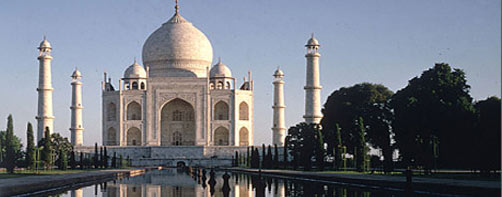
We are about to witness one of the greatest sights of one's lifetime - the Taj Mahal at sunrise. Before departure for the monument we shall be served tea/coffee and cookies so that our eyes open real wide to behold this breathtaking sight. A dawn visit to the fabled Taj Mahal to witness the magical effects caused by the reflections of the changing colours of the rising Sun on this brilliant white marble building.

Afternoon, we ride to the massive Agra Fort. The elegant buildings inside reflect an interesting synthesis of Hindu and Central Asian architectural styles. Built by Emperor Akbar, the maze of the courtyards, mosques & private chambers of the fort echo the story of the Mughal Empire. The Moti Masjid & other magnificent buildings reflect the skill of the ancient Indian architects.

Day 16: Agra / Jhansi (Shatabdi Express - 0840 / 1020)
Jhansi / Orcha / Khajuraho

Morning, transfer to the train station to board your Shatabdi Express to Jhansi.

Meeting and assistance upon arrival and drive to the medieval city of Orcha, in the state of Madhya Pradesh, seems to have frozen in time, its palaces and temples still retaining their original grandeur. The city, located by the side of the beautiful Betwa river, was founded by the Bundela Rajput chieftain, Rudra Pratap, in the 16th century.The word Orchha means 'hidden'. When the Tughlaqs, who were ruling Delhi in the 15th century, pushed the Bundelkhand rajas out of Garkhundar, they retreated to distant Orchha. Apart from the famous landmarks like Jehangir Mahal, the Laxminarayan Temple, the area is peppered with fascinating little shrines and memorials, all of which add to the overwhelming feeling of nostalgia, the city evokes in the visitor.

Following the tour we will have our lunch at a spectacular Amar Mahal Palace.

After the lunch, drive to Khajuraho.

Upon arrival check into your Hotel Jass

Sound & Light Show
Evening, we visit temple complex to enjoy Sound & Light Show, where the history of the temples is narrated through the medium of Sound & Light. This fascinating Son-et-Lumiere spectacle evokes the life and times of the great Chandela Kings and traces the story of the unique temples from the 10th century to the present day. Amitabh Bachhan, the Indian Super Star, narrates the story of Khajuraho in his mesmerizing voice

Day 17: Khajuraho

Morning, we meet our guide, and, proceed on a tour of the world famous western group of temples depicting erotic sculptures of love making images of Gods and Goddesses and celestial Nymphs. The sexual fantasies displayed in the sculptures are mind boggling. It speaks very highly of the artistic creativity and imagination of the sculptors.

Afternoon, we proceed on a guided tour of Eastern group of Temples .If pictures speak a thousand words, then the temples of Khajuraho form a magnum opus... an expression of Indian sculptors of yore. These temples of Khajuraho were built by the Chandela kings following the tradition of Tantric art. Although famed for their erotic sculptures, the philosophy behind the temples is much more vast and encompassing. They are in fact a celebration of life!

Day 18: Khajuraho / Delhi (9W 724 - 1330 / 1600)

Morning is at leisure to have some mild adventure in this very safe village of Khajuraho. You may hop on to a cycle rickshaw and ride through some of the remote tribal villages. You may also wish to walk to the western group of temples for a second visit.

Late morning transfer to the airport for your flight to Delhi.

Meeting and assistance upon arrival and transfer to your hotel The Connaught

Day 19: Delhi / Haridwar (Shatabdi Express - 0655 / 1130 Hrs)

Morning, transfer to the train station to take a ride on India's premier train service to Haridwar.

Meeting and assistance upon arrival and check into Hotel The Haveli Hari Ganga, a beautiful heritage "Haveli" (mansion) situated on the banks of the Holy Ganga, a mere 500 meters walk through the Bazaar from the sacred "Har ki Pauri" at Haridwar. It stands at the gateway to the Devbhumi - the abode of the Gods and the "Char Dham Yatra". The Haveli is an architectural marvel, where the ancient structure has been restored to recreate the old - world charm with modern day hospitality. The interiors of The Haveli are interestingly reminiscent of old Indian Mythological times where there are balanced tones of tranquility & comfort.

This evening we suggest you walk across over the bridge to witness the fascinating Ganga 'Aarti' (invocation). The golden reflection of floral diyas in the river Ganges is the most enchanting sight in the twilight during the Ganga aarti ceremony at the ghat. The synchronised chanting of prayers that takes place during the Aarti is a very uplifting experience.

Day 20: Haridwar / Rishikesh / Haridwar

Following a leisurely breakfast we proceed on a day return trip to Rishikesh.

Most of the pilgrims who pass through Rishikesh on their way to the Himalayan shrines of the Char Dham pause for a holy dip and puja at Triveni Ghat, There are a number of ashrams in and around Rishikesh, where rishis (saints) stay. Some of the ashrams are situated on the eastern bank of the river Ganges and the entire cluster is known as Swargashram. Maharishi Mahesh Yogi's Ashram is famous the world over for which the credit goes to the rock band Beatles. Several ashrams offer yoga courses and many pilgrims from in and around the country come here to learn yoga. Along with the ashrams, there are a few temples having some mythological importance.

Later we drive back to our hotel Haveli Hari Ganga in Haridwar.

Day 21: Haridwar

Today we explore the unending list of attractions in Haridwar is endless. Har-Ki-Pauri, the sacred ghat was constructed by King Vikramaditya in the memory of his brother Bhartrihari. Haridwar abounds with several Hindu temples and Ashrams (Hermitages). More than the architectural designs, it is the spiritual ambience of the place that is so striking. The Daksh Mahadev Temple is an ancient shrine situated to the south of Kankhal town. This temple was constructed by Queen Dhankaur in AD 1810. Kankhal has several other temples and ashrams too. The Sapt Rishi Ashram is situated along the Haridwar-Rishikesh road. The Ganges flows in seven streams in front of this Ashram, hence this place is also called Sapt Sarovar. The Kanva Rishi Ashram is situated around 42 km from Haridwar. The ashram is on the banks of the Malini River along the forest road to Kotdwar. Other important places to visit are the Bharat Mata Temple, Maya Devi Temple, Bhimgoda, and Shanti Kunj.

Day 22: Haridwar / Delhi
Delhi / Pathankot (Jammu Mail - 2110 / 0735*)

Following a leisurely breakfast, drive to Delhi.

Upon arrival in Delhi, transfer to the train station to board your overnight train to Pathankot.

Day 23: Arrival / Pathankot / Dharamshala.

Meeting and assistance upon arrival and drive to Dharamshala, a very scenic and peaceful hill station which has the added attraction of its strong Tibetan influence. It was here that the Dalai Lama and his followers had fled after the Chinese invasion of Tibet.

We would have opportunities to stop on the way to interact with the locals as well as to enjoy the incredible natural beauty of the region.

Upon arrival, check into Hotel Grace Cottage.

Afternoon is at leisure. We suggest you enjoy a walk along the mall road where Tibetan refugees display and sell their crafts.

Day 24: Dharamshala

Following breakfast, proceed on a tour of Dharamshala.

We visit the Norblinga Institute for Tibetan Buddhism which is perhaps one of its best in the world. The Institute has its own temple, museum, hospital and meditation hall. We would meet with monks here to learn more about Buddhism. Of special mention here are the magnificent miniature paintings done by students here. It is great to see the students sketch a design and then paint it on canvas.. We would visit the Dalai Lama's Palace and temple in the afternoon and meet with the spiritual leaders to know more about the plight of Tibetans, their future, the problems they face in India etc. If the Dalai Lama is their in Dharamshala at the same time as we are, every effort would be made to have a personal audience with him, the Tibetan Buddhism's deity of Universal Compassion. It is special meeting him, not because of his title or the high degree of reverence that the people of Tibet hold him in; but more because how it feels in his company. Several strong impressions remain about the meeting, including the way in which he gives his whole attention to questions. There is wisdom in his thinking which comes through clearly in his words, filled as they are with common sense and realism. His firm handshake, his sense of compassion, his sense of humour, his highly infectious and kind laughter are some of the everlasting images of the Dalai Lama.

Day 25: Dharamshala

This morning we would visit a residential school run by Tibetan refugees. It is heart rendering to see how these helpless people over the years have struggled to be self-sufficient. The love and compassion that exists between inmates is only to be seen to be believed. We would also visit the Tibetan crafts village where Tibetan refugees are imparted training for making various handicrafts, carpets as well as tailoring.

Day 26: Dharamshala / Amritsar

Following a leisurely breakfast, drive to Amritsar.

In the evening we journey 40 Kms to Wagha, the border between India & Pakistan. Each evening a very impressive lowering of guards ceremony is performed along with a march past by soldiers of both countries in synchronization to the accompaniment of bugles. The soldiers of both countries wear ceremonial dresses. It is quite a spectacular sight to see the same thing happening on both sides of the border.

Day 27: Amritsar

Following breakfast we visit the Golden Temple, which is the Mecca of Sikh religion .The temple with a shinny pure gold dome, is beautifully situated in the center of a lake (The Holy Tank). And is approached by a causeway .All around the lake are marble walkways and various other temple buildings. The community kitchen, which feeds over a thousand people continuously, is spectacular. The huge utensils to prepare the food and the chapattis (breads) - 20 to 25 at a time - are a mind-boggling sight. However, besides the physical beauty of the place, the strong and tranquil spiritual atmosphere of the place is soul stirring without being overwhelming. The constant recitation of the holy book brings a certain sense of peace to the individual. We walk through the temple complex and try soak in the atmosphere. We would also have an opportunity to meet some Sikh religious leaders who would talk to us about the basic tenets of Sikhism.

Just outside the Golden Temple are various shops that sell Sikh religious artifacts like swords (decorative), bracelets, combs, small daggers etc.

During the day, we would also visit the Jalianwala Bagh, the martyr's memorial where thousands of innocent Indians were cordoned off by the British and fired. The well where several Indians jumped to escape the bullets as well as bullet marks and a museum of pictures can be still seen here.

We would also be visiting the Golden Temple after dinner. There happens a spectacular ceremony, where the Sikhs put their holy book (Guru Granth Sahib) to sleep. The priests carry the books over their head to place them in a golden palanquin. The book is then carried to an inner chamber in the Palanquin to the accompaniment of bugles and drums and the chanting of the name of the Lord. The palanquin itself is carried by devotees in turns. It is quite a special sight. The book is again placed in the main sanctum similarly in the morning.

Day 28: Amritsar / Delhi (Amritsar Shatabdi - 0510 / 1105)

Morning, transfer to the train station to board Amritsar Shatabdi to Delhi.

Following a leisurely breakfast, drive to Delhi.

Upon arrival check into your Hotel The Connaught.

Rest of the day is at leisure for your independent activities.

However we suggest you to visit Dilli Haat, a project conceived with the basic idea of providing encouragement and exposure to needy artisans and craftsmen all over the country who often spend their lives within the confines of their own village and town. The success of the project lied in freeing the craftsman and the artisan from the stranglehold of the middlemen and bringing them into direct contact with buyers both within the country and outside. Dilli Haat offers the visitor not only the arts and handicrafts of the country at one place, but also the cuisine and performing arts from different parts of the country. While developing the concept, it was kept in mind that when a 'Haat' comes to the city, it has to adjust to urban contemporary needs while retaining the cultural ambience familiar to rural crafts people.

Day 29: Delhi / Departure

Transfer to International airport for your onward flight back home.

Indicative Low Season Cost Based on 02 People Traveling Together: - USD 2445 Per Person


Cost Includes: Accommodation on twin sharing basis; Daily American Breakfast; Home Dinner with an Indian family; An Air-conditioned Private Car for all journeys and tours as per Itinerary; Local guides for city tours as per the itinerary; Elephant Ride at Amber Fort; Jeep Safari at Rohet; Camel ride at Sam; Inner India Airfare for Khajuraho / Delhi Sector in Economy Class; Air-conditioned Sleeper (Overnight Journey)/Air-conditioned Seating (Day Journey) Train accommodation.

Destinations India offers online reservation for The Spirit of India Tour Itinerary, India. For details please fill up the form given below.